

Introduction
The global trade of natural dimension stone represents a multi-billion-dollar industry where the aesthetic allure of geological materials intersects with rigorous structural engineering and international logistics. As countries like Turkey, Italy, Greece, and Iran export millions of tons of natural stone annually, the necessity for standardized quality control (QC) frameworks has become paramount. Unlike engineered materials such as sintered stone or synthetic quartz, natural stone is inherently heterogeneous, shaped by millions of years of geological and tectonic processes. Consequently, a traditional, visual-only approach to quality evaluation is entirely insufficient for the modern export market. Today's global architecture relies on a highly integrated quality control pipeline spanning from the extraction face of the quarry to the final container lashing protocols at the port of departure.
To guarantee the quality of export stones—whether they are dense granites, recrystallized marbles, or porous travertines—producers must implement exhaustive Factory Production Control (FPC) systems. These systems are governed by international consensus standards, most notably the European Norms (EN) formulated by the European Committee for Standardization (CEN) and the standards published by ASTM International. This comprehensive report unpacks the deeply technical mechanisms of sorting, processing, physical testing, and packaging that define export-grade natural stone, culminating in an analysis of the key performance indicators that dictate success in the global dimension stone market.
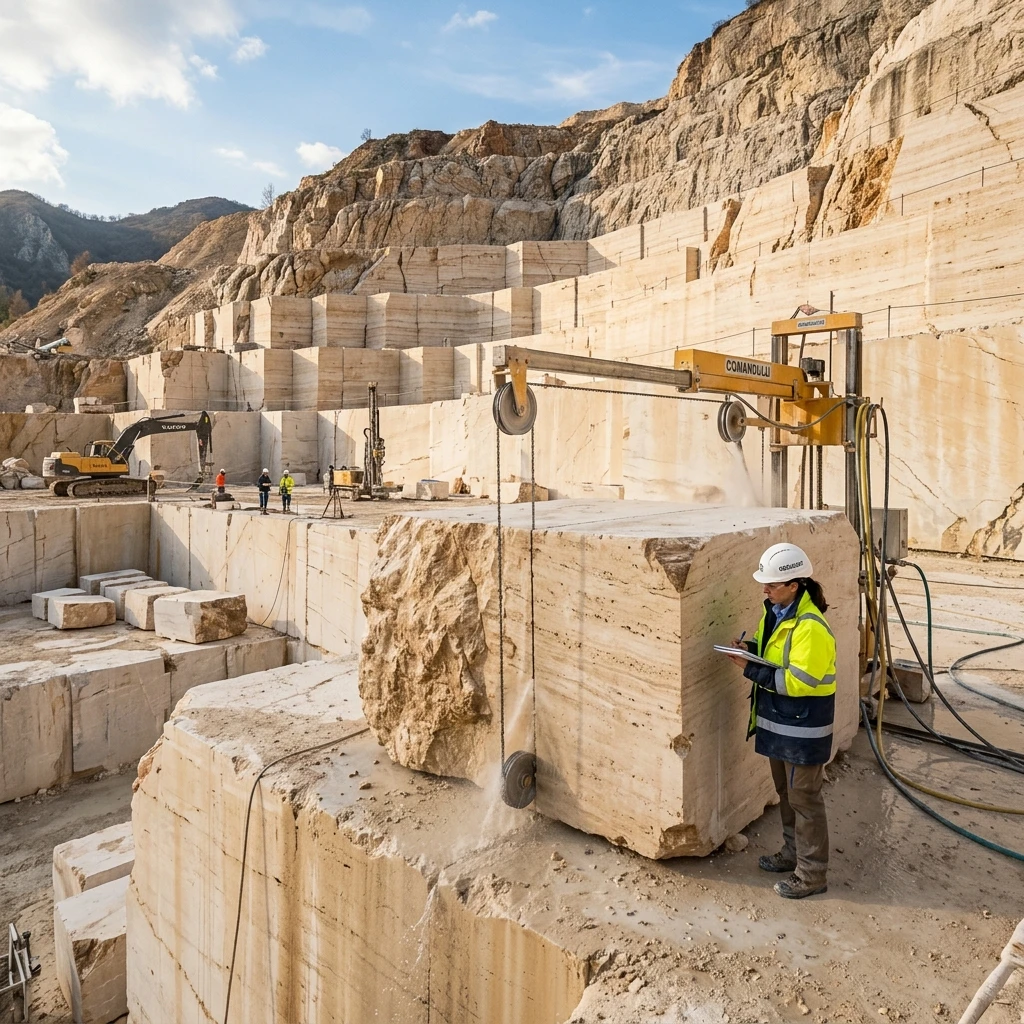
Geological Assessment and Quarry-Level Quality Control
The foundational phase of natural stone quality control begins long before a block reaches the gang-saw; it originates at the quarry face. The efficiency and precision of extraction directly dictate the economic output, the environmental performance, and the ultimate structural integrity of the processed slabs.
Petrophysical Anomalies and Selection Criteria
Every geological deposit exhibits variations based on the horizontal extraction bench and the vertical extraction depth. As the quarrying face advances, the mineral composition, background tone, fossil density, and veining characteristics shift continuously. For example, a beige marble extracted from lower depths may yield a clean, uniform background, while upper benches might present high fossil density or intricate calcite veining.
Quality control engineers must conduct meticulous visual and technological inspections of raw blocks to identify sub-classifiers of structural weakness. According to geological classification standards, several intrinsic anomalies can drastically reduce the market value and mechanical viability of a stone:
- Grain Size Variability: Abrupt variations where grains become suddenly coarser or finer can act as stress concentrators during physical loading.
- Foliation and Laminae: Pervasive planar structures, common in metamorphic rocks, can lead to parting—the physical separation of rock along its mineralogical layers.
- Banding: Tabular layers differing in mineral composition or color must be carefully assessed, as the interface between bands often represents a plane of mechanical weakness.
- Pores and Cavities: While inherent to rocks like travertine, excessive vuggy porosity in other lithologies compromises structural integrity and increases susceptibility to moisture-induced degradation.
Experienced quarry inspectors look for micro-fissures, hairline fractures, and deep-seated staining lines that are often invisible beneath the dusty exterior of a raw block. Slabs cut from inherently flawed blocks may shear under the immense tension of multi-blade gang-saws, reducing usable yield and driving up production costs. To mitigate these risks, advanced extraction operations utilize Ground Penetrating Radar (GPR) to scan blocks for internal fractures before they are cleared for cutting. Furthermore, high-value, fragile blocks—such as highly veined calcitic marbles—are proactively wrapped in reinforcing fiberglass mesh and vacuum-treated with epoxy resins at the quarry or factory to prevent catastrophic splitting during the sawing phase.
Extraction Mechanics and Block Stabilization
The methods utilized for stone extraction also play a vital role in preserving the integrity of the material. Controlled hydraulic splitting, diamond wire sawing, and precise drilling are preferred over aggressive blasting techniques. By documenting parameters such as hole spacing, hydraulic pressure stages, and cycle times, quarry operators can refine subsequent extraction rounds to minimize induced micro-cracking. Densely spaced boreholes generate finer fragments, whereas larger spacing favors intact block formation, provided the natural jointing of the rock allows for it. In karst environments, operators face additional challenges such as sudden collapses and water inflows, requiring highly adaptive dewatering and safeguarding strategies.
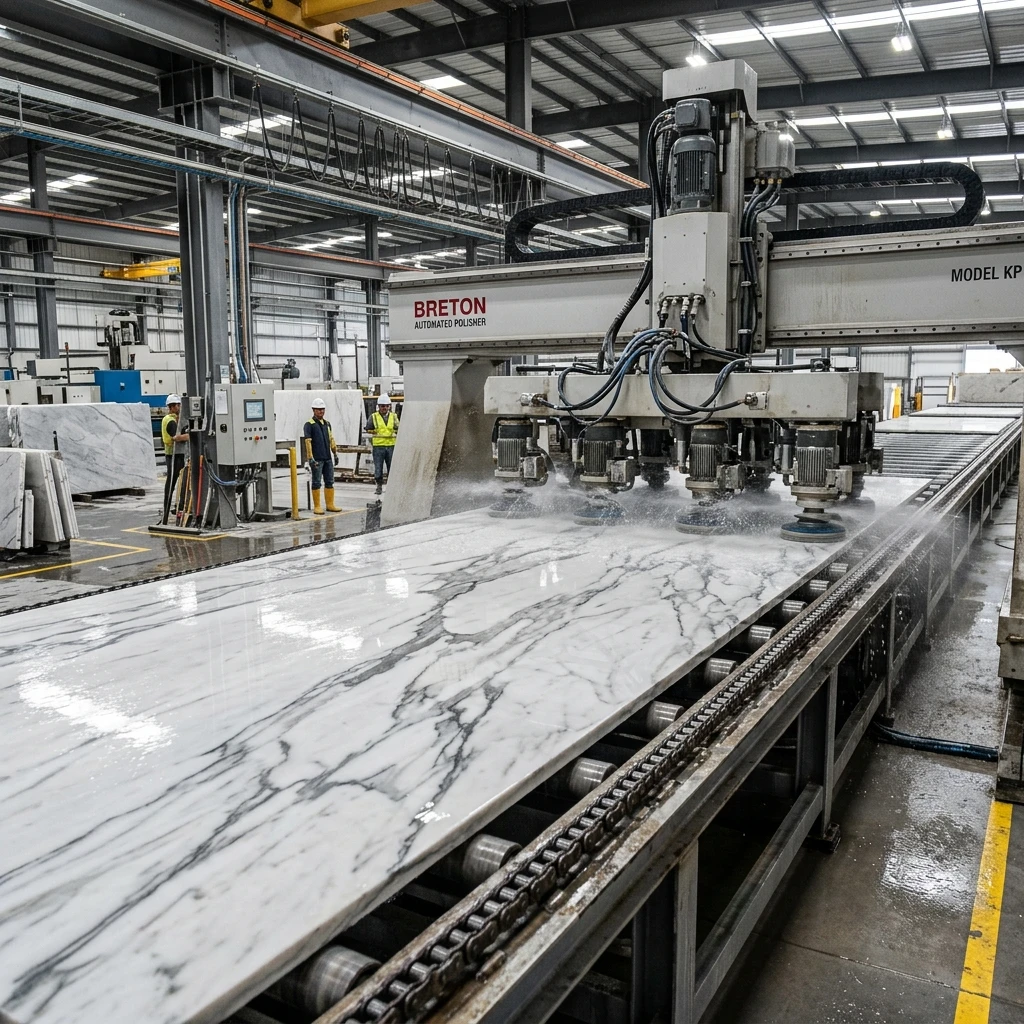
How to Guarantee the Quality of Export Stones: Sorting and Processing Criteria
Once raw blocks are transported to the processing facility, they enter a highly automated pipeline of multi-blade gang-saws, block-cutting machines, and continuous polishing lines. The precision applied during these stages dictates whether the final product will meet stringent export specifications or be relegated to the domestic secondary market.
Dimensional Tolerances and Processing Precision
The international market demands extraordinary precision, particularly for projects utilizing dry-lay facade cladding or ultra-thin mortar beds. Adherence to strict dimensional tolerances is non-negotiable. European standards such as EN 12057 (for modular tiles ≤ 12 mm thick) and EN 1469 (for slabs used in cladding) define the exact permissible deviations in length, width, thickness, and squareness.
For calibrated modular tiles, the tolerances are particularly unforgiving. Calibrated tiles undergo specific mechanical finishing on the reverse side to ensure uniform thickness, making them suitable for thin-set adhesive installation.
| Dimensional Property | Not Calibrated Tiles (EN 12057) | Calibrated Tiles (EN 12057) |
|---|---|---|
| Length & Width | ± 1.0 mm | ± 1.0 mm |
| Thickness | ± 1.5 mm | ± 0.5 mm |
| Flatness (Polished/Honed) | 0.15% | 0.10% |
| Squareness | 0.15% | 0.10% |
The use of CNC infrared cutting machines allows modern factories to achieve these precise tolerances, maintaining deviations of ± 0.5 mm, which is absolutely critical for continuous wall-matching and ventilated facade alignment.
Flatness Tolerance: A Critical Export Parameter
Flatness tolerance is not merely an aesthetic attribute; it is a measurable structural condition that defines the permissible deviation of a slab's surface from a true geometric plane. Measurement is executed using calibrated straight edges placed longitudinally, transversely, and diagonally across the stone. For export-grade polished granite slabs with a standard thickness of 18 to 20 mm, the market explicitly expects deviations to remain between ± 0.5 to ± 1.0 mm over a one-meter length, with a maximum total bow of 2 to 3 mm across a full slab length (typically 2800 to 3200 mm).
Non-compliance in flatness renders a slab commercially problematic. Cupped or bowed slabs cannot rest evenly on CNC fabrication tables, their joint alignment results in visible lippage (uneven edges between adjacent installed stones), and mechanical anchoring points fail to align correctly on structural sub-frames. While thicker slabs (e.g., 30 mm) offer increased rigidity and resistance to deformation, thickness alone does not eliminate stress-induced bowing. Internal mineral structures and processing disciplines—such as allowing freshly cut slabs to rest vertically before polishing to release residual stress—are decisive factors in maintaining flatness.
Aesthetic Sorting, Spectrophotometry, and Delta E Thresholds
Sorting natural stone is an intricate process that seeks to impose order upon geological randomness. Because stones from different benches of the same quarry will rarely match perfectly, specifiers for large-scale commercial installations must secure sequential slabs cut from the same block to ensure visual continuity. Failing to plan for this variation leads to mismatched panels during dry-lay inspections, causing severe project delays.
Professional export sorting has moved beyond subjective visual checks to rely on spectrophotometer delta E (ΔE) lot verification. The ΔE metric quantifies the mathematical difference between two colors in a defined color space. Importers utilize strict protocols to match production panels against a master sample under standardized D65 lighting (daylight equivalent at 6500K).
The acceptance thresholds for color matching are rigorously defined:
- ΔE < 2.0: This represents the optimal, fully acceptable range for seamless aesthetic blending.
- ΔE 2.0 – 3.0: This is a marginal range. Panels falling in this band must be segregated. If more than 10% of a sampled batch falls within this marginal zone, inspectors must escalate to a full 100% crate-by-crate inspection.
- ΔE > 3.0: Panels in this range are visually distinct to the human eye. This constitutes a rejectable offense, prompting immediate container holds and supplier notifications.
Beyond color, sorting must also account for vein pattern ratios. If a master sample consists of 50% heavy-vein and 50% light-vein material, the shipped crates must accurately reflect this distribution. A crate containing an excessive percentage of a specific vein pattern that disrupts the intended architectural ratio will be rejected, even if the individual stones are structurally sound.
Comprehensive Guide to Quality Control and Physical Testing of Building Stones
To protect end-users and ensure long-term structural integrity, architectural specifications legally mandate that dimension stones meet specified ASTM or EN testing standards before installation. Without these quantifiable metrics, designers run the risk of specifying soft, porous, or reactive stones for hostile environments, leading to rapid degradation. The following represents a comprehensive guide to the physical testing protocols necessary for natural stone QC.
Porosity, Absorption, and Density (ASTM C97 vs. EN 13755)
Water absorption is an indirect measure of a stone’s open porosity and acts as a primary indicator of its susceptibility to staining, chemical attack, and freeze-thaw deterioration. While both the American (ASTM) and European (CEN) standard bodies evaluate the same fundamental properties, their methodological approaches differ significantly, often resulting in non-correlating values.
- ASTM C97 / C97M: This standard determines both the absorption and bulk specific gravity of dimension stone. Specimens are dried in a ventilated oven for 48 hours to obtain their absolute dry weight. They are then completely immersed in a water bath without delay for an additional 48 hours, surface-dried, and weighed again. The difference represents the absorption value.
- EN 13755 & EN 1936: The European counterpart for water absorption at atmospheric pressure (EN 13755) utilizes a more gradual immersion technique. The specimen is immersed to only one-half of its depth for the first hour, to three-quarters of its depth for the second hour, and only completely immersed for the remainder of the testing period. This gradual immersion prevents trapped air from creating artificial pneumatic pressure within the stone's capillaries, leading to a more accurate representation of open porosity, especially in highly vuggy stones like travertine.
Compressive Strength (ASTM C170)
Compressive strength measures a stone's resistance to crushing under a heavy uniaxial load. This test requires cubic or cylindrical specimens measuring between 2 and 3 inches in all dimensions. A hydraulic ram applies downward pressure until the specimen suffers catastrophic failure.
For dense igneous rocks like granite, compressive strength easily exceeds 150 MPa. However, for sedimentary and porous chemical precipitates like travertine, the uniaxial compressive strength (UCS) is highly variable and heavily controlled by the orientation of its natural laminae. Travertines generally exhibit compressive strengths ranging from 30 to 100 MPa (approximately 4,300 to 14,500 psi). While lower than granite, compact facies of travertine still possess ample compressive strength for both high-end structural and flooring applications, provided their open porosity is correctly managed.
Flexural Strength and Modulus of Rupture (ASTM C880 vs. ASTM C99)
For vertical cladding and horizontally suspended paving, gravity and wind load exert bending moments rather than pure compressive forces. Measuring a stone's bending strength is arguably the most critical structural metric in modern stone architecture. Two primary ASTM tests evaluate this property, but they yield vastly different insights.
- Modulus of Rupture (ASTM C99): In this procedure, a relatively short, thick stone specimen is supported near its ends to form a bridge, and a single-point downward load is applied directly to the mid-span until the stone fractures. Because the maximum bending stress is heavily concentrated at a single microscopic point in the center, this test often fails to expose localized structural weaknesses, natural veins, or micro-cracks located closer to the support edges.
- Flexural Strength (ASTM C880 / EN 12372): To address the shortcomings of C99, ASTM C880 was developed specifically for dimension stone cladding. This test differs in two critical ways. First, it requires test specimens that match the exact thickness and surface finish of the stone intended for the actual building application. Second, it utilizes quarter-point loading. Instead of a single central ram, the load is split and applied at two points equidistant from the center. This configuration ensures that the entire central half of the stone's span is subjected to the exact same maximum bending moment. Any local weakness, micro-crack, or soft vein located anywhere within the central half will be exposed and cause failure. Consequently, ASTM C880 provides a vastly superior and more conservative structural metric, making it the preferred standard for facade engineers.
The TEAM Project and Marble Bowing (EN 16306)
One of the most complex phenomena affecting building facades is the irreversible plastic deformation of natural stone panels, known as bowing, warping, or dishing. This pathology predominantly affects carbonate rocks, specifically calcitic marbles, and can cause significant loss of intergranular cohesion, reducing the stone's strength by 40% to 60% over a decade. A high-profile instance of this occurred at the Finlandia Hall, where Carrara marble claddings deformed so severely that the entire facade required replacement.
The European TEAM (Testing and Assessment of Marble and limestone) project was initiated to investigate the mechanics behind this degradation. Research demonstrated that bowing is an intrinsic pathology resulting from the extreme thermal anisotropy of calcite crystals combined with moisture gradients. Calcite belongs to the trigonal-hexagonal mineralogical system. When heated by solar radiation, the crystals undergo a massive expansion parallel to their crystallographic c-axis (α11 = 26 × 10-6 K-1), while simultaneously contracting perpendicularly to the c-axis (α22 = -6 × 10⁻⁶ K-1).
This contradictory multidirectional movement causes neighboring crystals to push against each other, breaking the mechanical interlocking bonds (intergranular decohesion). When the stone cools, the crystals do not perfectly return to their original positions (hysteresis). The repeated thermal cycling, exacerbated by moisture entering the newly formed micro-cracks from the rear of the ventilated facade, leads to permanent convex or concave deformation.
To mitigate this risk, the EN 16306 standard was established. This accelerated aging test places marble specimens in an apparatus where they are subjected to moisture from beneath and heating from above, cycling between 20°C and 80°C for 50 continuous days (cycles). The resulting deformation is meticulously measured to classify the marble's long-term viability. Microscopic imaging techniques, such as Adjacent Grain Analysis (AGA) and Total Optical Porosity (TOP), are also employed to assess the grain shape and porosity indices, which correlate strongly with a marble's propensity to bow. Only marbles that pass the EN 16306 thresholds should ever be specified for exterior cladding in regions with high solar radiation and temperature differentials.
5 Important Indicators in Guaranteeing the Quality of Marble and Travertine for Export
To achieve a competitive edge in international markets, exporters cannot rely solely on the raw beauty of their geological reserves. Successful export operations build their reputation upon a foundation of strict, verifiable performance indicators. For premium calcareous stones such as marble, mermerit (compact limestone/marble), and travertine, the following five indicators are decisive in guaranteeing export quality.
1. Precision Dimensional Calibration and Minimal Tolerance Limits
In contemporary architecture, the shift toward minimalist, large-format paneling and dry-lay installations means that even sub-millimeter deviations can ruin a project's visual flow. Quality must be guaranteed through rigorous adherence to standard dimensional matrices (e.g., ASTM C503 for Marble, ASTM C1527 for Travertine).
| Physical Property | ASTM C1527 Travertine (Exterior) | ASTM C503 Marble (Calcite) |
|---|---|---|
| Max Absorption by Weight (%) | 2.5 | 0.20 |
| Min Density (kg/m³) | 2305 | 2600 |
| Min Compressive Strength (MPa) | 52 | 52 |
| Min Modulus of Rupture (MPa) | 6.9 | 6.9 |
| Min Abrasion Resistance (Ha) | 10 | 10 |
Export stones must demonstrate strict calibration. A thickness tolerance deviation greater than ± 1 mm across a 600 mm span not only creates shadow lines resembling defects but also prevents mechanical anchor systems from seating properly within structural facade rails.
2. Spectrophotometric Batch-to-Batch Color Consistency
Foreign buyers are acutely sensitive to color uniformity. Aesthetic sorting must transition from subjective human visual checks to data-driven spectrophotometry. By utilizing the ΔE parameter under standardized D65 lighting, factories must guarantee that the variation across an entire shipment of thousands of square meters remains below the critical 2.0 to 3.0 threshold. Furthermore, the natural vein direction—whether the stone is vein-cut (perpendicular to bedding) or fleuri-cut/cross-cut (parallel to bedding)—must be maintained with absolute consistency across sequential slabs.
3. Mechanical Integrity and Verified Anchor Strength
Export-grade stone is expected to withstand decades of harsh environmental exposure. The structural viability of the material must be continuously verified. For instance, testing under ASTM C1354 (Strength of Individual Stone Anchorages) provides the ultimate load capacity of an assembly consisting of the stone and its mechanical anchor. Slabs must be devoid of structurally compromising stylolites, large uncemented vugs, or deleterious veins that might shear under wind loads. High dynamic modulus of elasticity (tested via fundamental resonance frequency per EN 14146) serves as a non-destructive indicator of internal solidity.
4. Advanced Surface Treatment and Polymeric Pore Filling
This indicator is particularly critical for travertine. Travertine's defining characteristic—its porosity caused by carbon dioxide degassing during its precipitation near hot springs—requires intensive factory management. While this porosity provides excellent mortar adhesion and reduces the building's dead load, unfilled surface voids are susceptible to dirt accumulation and freeze-thaw damage. Export-grade travertine requires deep-penetrating, high-quality polymeric resin treatments that seamlessly match the stone's natural tone. The resin must be cured uniformly in controlled ovens to prevent shrinking, yellowing, or popping out during the final calibration and polishing phases.
5. Export-Grade Packaging and ISPM-15 Phytosanitary Compliance
The finest marble slab loses its value entirely if it arrives at the destination port cracked, stained, or quarantined. Packaging is not an afterthought; it is an engineered component of the product. Premium export packaging utilizes heavy-duty, customized wooden crates or steel A-frames designed to absorb the kinetic energy of ocean freight and port handling. Furthermore, all wooden packaging materials must be heat-treated (HT) or dielectric heated (DH) and stamped with the ISPM-15 mark to comply with international phytosanitary regulations, preventing the cross-border spread of invasive pests. Failure to provide ISPM-15 certification results in immediate container rejection and costly destruction of materials at customs.
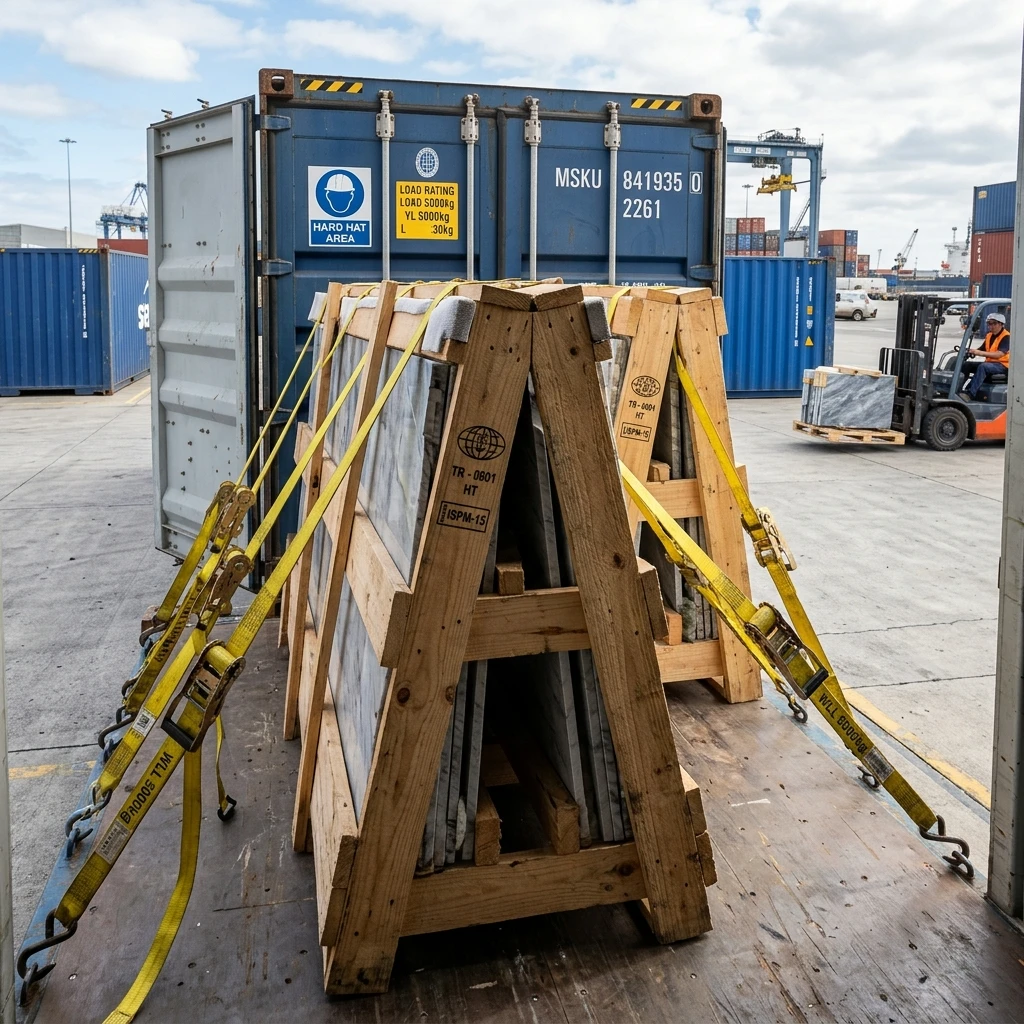
Export Logistics, Packaging, and Phytosanitary Compliance
The final frontier of quality control lies in protecting the finished stone during its journey from the factory to the international job site. Logistics and packaging failures are the leading cause of insurance claims in the dimension stone industry.
Structural Crating and A-Frame Mechanics
Natural stone products are uniquely challenging to transport due to their extreme density and low tensile flexibility. A standard 20-foot shipping container will reach its maximum payload capacity (approximately 18 to 22 tons) long before its volumetric space is filled.
To protect against shock, vibration, and handling stress, packaging must adhere to strict structural standards such as ASTM D6251, which classifies wood-cleated panelboard shipping boxes. Export shipments demand Class 2 crates, engineered to handle heavier loads (up to 1000 lbs per unit) and rougher overseas transit.
- Modular Tiles: These are packed tightly into fumigated wooden crates. A high-density EPS foam sheet (typically 20 mm thick) is laid at the base, and tiles are separated by non-staining slip sheets or thin polystyrene to prevent friction-induced scratches.
- Large Slabs: Slabs must never be shipped horizontally. They are bundled vertically on robust steel or wooden A-frames and L-frames. This vertical orientation leverages the stone's compressive strength and drastically minimizes bending stresses that cause breakage. Slabs with polished faces are always packed face-to-face, separated by a protective plastic sheet to preserve the high-gloss finish.
ISPM-15 Compliance and ASTM D6251 Standards
The International Standards for Phytosanitary Measures No. 15 (ISPM-15) mandate that all solid wood packaging materials used in international trade must be treated to eradicate pests like the pinewood nematode and the Asian longhorned beetle. Exporters must utilize timber that has been subjected to approved heat treatments and clearly stamped with the globally recognized IPPC mark. A crate that meets the structural integrity rules of ASTM D6251 but lacks ISPM-15 stamping will still face quarantine, fumigation at the importer's expense, or complete rejection at European or North American borders.
Container Loading and Lashing Protocols
The process of "stuffing" the container requires precise weight distribution engineering. Heavier crates are positioned at the base and toward the rear axles to maintain balance. Because the stone does not fill the container's volume, extensive dunnage (filler material), wooden blocking, and anti-slip rubber matting must be employed. Finally, heavy-duty lashing straps and ratchet belts secure the crates to the container's internal anchor points. The goal is to completely immobilize the cargo, as even a few millimeters of lateral movement during a stormy 14-day sea transit generates enough kinetic energy to shear off slab edges.
Advanced Inspection Frameworks: ISO 2859-1 and AQL Methodology
Smart importers and distributors do not blindly accept shipments upon arrival. They treat the port inspection as a hard gate, utilizing statistical sampling mechanisms to verify quality before releasing final payments. The global standard for this process is ISO 2859-1 (Sampling procedures for inspection by attributes).
The Acceptance Quality Limit (AQL) dictates the maximum percentage of defective products that can be considered satisfactory in a specific lot. Because natural stone exhibits inherent geological variability, relying on standard consumer goods inspection levels (like General Inspection Level II) is highly insufficient. Stone inspectors must utilize General Inspection Level III to increase the sample size and accurately capture hidden edge cracks or subtle color shifts.
Defects are categorized rigidly:
- Critical & Major Defects (AQL 0.65): These include cracks that penetrate the full thickness of the panel, edge chips exceeding 10 mm, dimensional deviations beyond ± 2 mm, or severe ΔE color mismatches.
- Minor Defects (AQL 2.5 or 4.0): These encompass non-structural flaws such as superficial hairline cracks, minor pitting under 3 mm, or removable surface efflorescence.
To execute the inspection, the total lot size dictates a code letter from the ISO tables, which in turn defines the required sample size and the exact "Accept" (Ac) and "Reject" (Re) thresholds. For instance, if an inspector samples 315 panels from a massive shipment under an AQL of 0.65, finding 5 major defects allows the shipment to pass, but finding 6 major defects forces an automatic rejection of the entire lot. This mathematical approach eliminates subjective arguments between buyers and suppliers, grounding the export trade in objective, verifiable data.
Conclusion
The successful export of natural dimension stone requires a paradigm shift from traditional, craft-based quarrying to advanced, data-driven manufacturing and logistics. As international regulatory bodies expand the requirements for CE Marking and Environmental Product Declarations (EPDs), the barrier to entry for global markets continues to rise.
To compete effectively against the massive export volumes of countries within the European Union and emerging manufacturing hubs, stone producers must internalize rigorous Quality Control protocols at every juncture. This involves embracing non-destructive evaluation tools like GPR at the quarry face, enforcing sub-millimeter tolerances on CNC cutting lines, and abandoning subjective aesthetic checks in favor of spectrophotometric ΔE color matching.
Furthermore, a profound understanding of physical mechanics—such as the anisotropic thermal expansion of calcite that causes bowing, or the critical difference between mid-span and quarter-point flexural testing—is essential for matching the correct stone to the correct architectural application. Ultimately, when pristine geological materials are combined with ISPM-15 compliant, structurally engineered packaging and verified through strict AQL sampling frameworks, exporters mitigate the vast logistical and financial risks of cross-border trade. By adhering to these exhaustive standards, stone producers not only protect the integrity of their materials but secure their reputation and competitive viability in the global architectural arena.